
CLIENT EDUCATION SERIES | BUSINESS VALUATION INSIGHTS
SBA Business Acquisitions Are Changing on October 1, 2026 — Here’s What You Need to Know
By Christian Schweizer, MBA, CVA — September 4, 2026
Buying a business with SBA financing is about to involve a little more scrutiny. Beginning October 1, 2026, the U.S. Small Business Administration’s new SOP (Standard Operating Procedure) 50 10 8.1 changes the financial due-diligence requirements for SBA-financed business acquisitions. Two changes stand out: independent business valuations become more broadly required, and certain acquisitions of $3 million or more will also require an independent Quality of Earnings (QoE) report.
For buyers, sellers, lenders, CPAs, business brokers and M&A professionals, these are important changes to understand before the next deal gets too far down the road.
What Changes on October 1?
The easiest way to understand the new SBA requirements is to separate two different requirements: an independent business valuation and a Quality of Earnings (QoE) report. They are not the same, and they have different thresholds.
Before October 1, 2026, under the prior SBA rules, an independent business valuation from a Qualified Source was required only when the applicable amount being financed for the business acquisition exceeded $250,000 (subject to certain exceptions). Also, an independent valuation could as well be required when the buyer and seller had a close relationship. As a result, certain smaller transactions did not require an independent valuation from a Qualified Source at all. Importantly, the $250,000 threshold applied solely to the independent business valuation requirement. Under the prior SBA rules, there was no SBA requirement to obtain an independent QoE (Quality of Earnings) report, regardless of the purchase-price.
As of October 1, 2026: Under SOP 50 10 8.1, the $250,000 threshold for an independent business valuation has been eliminated, meaning an independent business valuation from a Qualified Source is required for SBA change-of-ownership transactions regardless of the size of the transaction.
There is also a separate new requirement for larger transactions. For qualifying Initial Acquisition and Business Expansion transactions with a Business Purchase Price of $3 million or more, the lender must also obtain an independent Quality of Earnings report.
Simply put:
Under the new rules, as of October 1, 2026:
- SBA change-of-ownership transaction, regardless of size
→ Independent business valuation required - Qualifying Initial Acquisition or Business Expansion with a Business Purchase Price of $3 million or more
→ Independent business valuation + independent QoE required
In other words, $250,000 was the old threshold associated with independent business valuations. The new $3 million threshold relates to the separate and new QoE requirement. These two thresholds should not be confused.
The official requirements are contained in SBA SOP 50 10 8.1, effective October 1, 2026, including Appendix 15 addressing change-of-ownership transactions. The SBA has also released lender training addressing the new requirements.
Why Both a Valuation and a QoE?
At first glance, requiring both reports may seem redundant. It isn’t.
They answer two fundamentally different questions:
Business Valuation answers the question: What is the business worth?
Quality of Earnings answers the question: How much of the earnings being presented is actually supportable and sustainable?
Imagine a business being sold for $4 million. The seller presents adjusted EBITDA of $900,000 after adding back owner compensation, personal expenses and several supposedly nonrecurring costs. A QoE analysis digs into those numbers and may conclude that sustainable normalized earnings are actually $725,000. The business valuation then considers those earnings; together with the company’s risks, growth, market evidence and other factors to determine what the business is really worth.
The new QoE requirement also goes beyond simply reviewing an EBITDA spreadsheet. Among other procedures, it includes a Cash Proof, comparing and reconciling the company’s financial information with underlying cash activity over the required periods.
After all, an Excel spreadsheet can say many things. Bank activity tends to be somewhat less imaginative.
Choosing the Right Professionals Matters
The new requirements will naturally create more demand for valuation and financial-due-diligence services. But not every financial professional automatically qualifies to perform every part of the work.
For the business valuation, SBA requires an independent Qualified Source meeting its professional qualification requirements. Recognized business-valuation credentials include the Certified Valuation Analyst (CVA) designation, among others.
For the Quality of Earnings, SBA uses a different standard. The QoE must be performed by an independent, experienced financial professional for the benefit of the lender. This distinction matters.
A business valuation is not simply an accounting exercise, and a QoE is not simply a valuation with a different title. The professionals involved need to understand the applicable SBA requirements, financial normalization, supporting documentation, cash reconciliation and the economics of privately held businesses.
There may also be advantages to having the valuation and QoE performed through a coordinated process. Although they remain separate analyses and deliverables, they rely on much of the same underlying financial information.
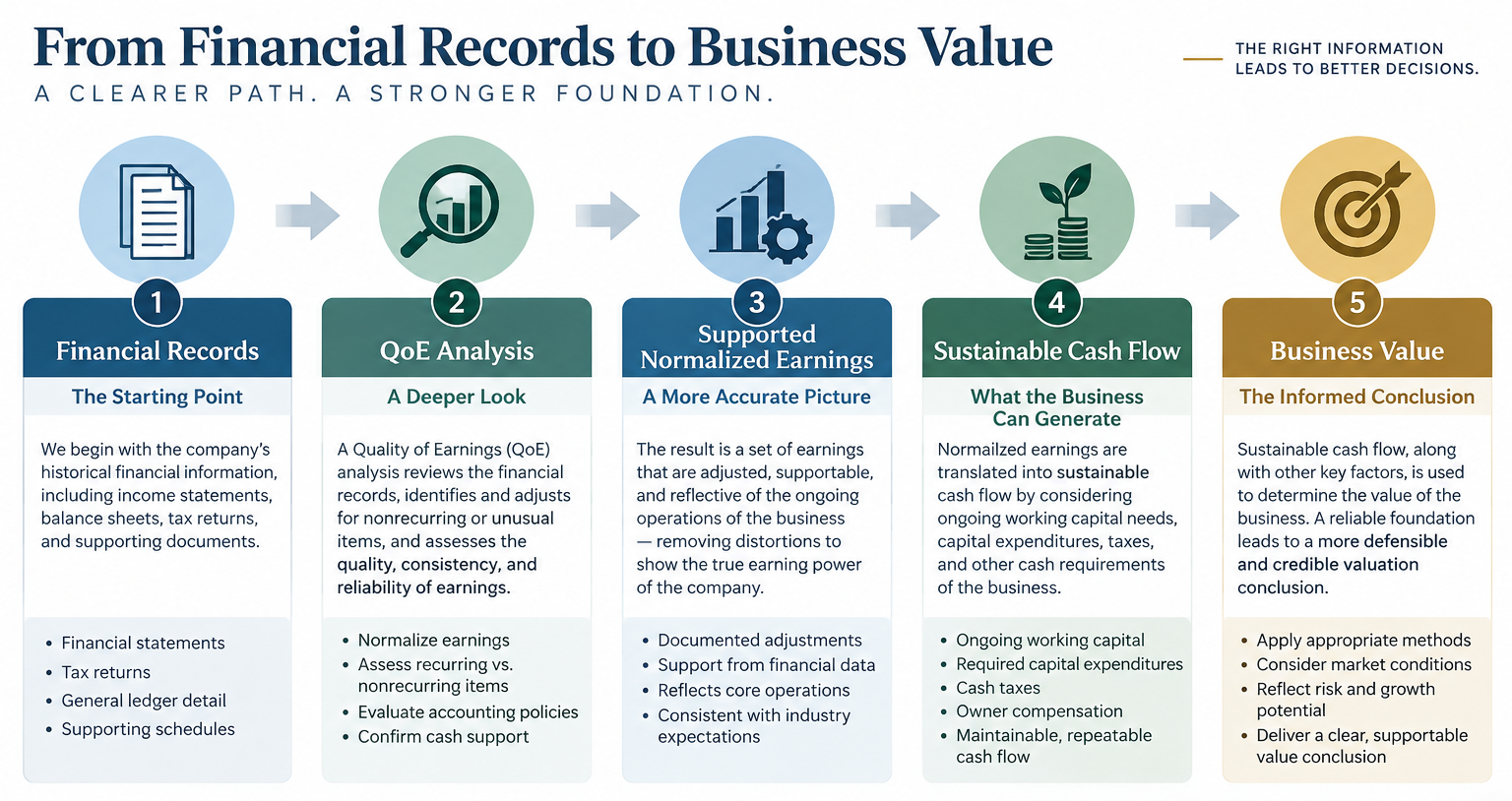
A well-coordinated engagement creates a logical progression:
Financial records → QoE analysis → supported normalized earnings → sustainable cash flow → business value
That can reduce duplication, lower the fees for the service, and, more importantly, help ensure that the earnings underlying the valuation are consistent with those established through the QoE.
Where LP Business Valuation Fits
LP Business Valuation LLC specializes in the valuation and financial analysis of privately held businesses. Valuations are led by a Certified Valuation Analyst (CVA) credentialed by the National Association of Certified Valuators and Analysts (NACVA), a professional valuation credential recognized under SBA’s Qualified Source requirements.
LP Business Valuation’s work includes business valuation, financial normalization, transaction analysis and financial due diligence. These capabilities position the firm to assist with SBA business valuations and, coordinated Quality of Earnings analysis under the new framework and rules.
The objective is not simply to produce two more reports for the closing checklist. It is to provide the lender and transaction parties with a consistent, independent financial picture of the business being acquired.
The Bigger Picture
The October 1 changes may initially sound like additional SBA paperwork. But the principle behind them is straightforward. Before financing the purchase of a business, two questions deserve independent scrutiny:
1) What does this business really earn?
2) And what is it really worth?
The QoE helps answer the first. The business valuation helps answer the second.
This article is intended for general educational purposes and does not constitute a formal valuation opinion or engagement. Business valuations performed by this firm are conducted in accordance with the National Association of Certified Valuators and Analysts (NACVA) Professional Standards. For questions about your specific situation, please contact us.
Go to Articles overview